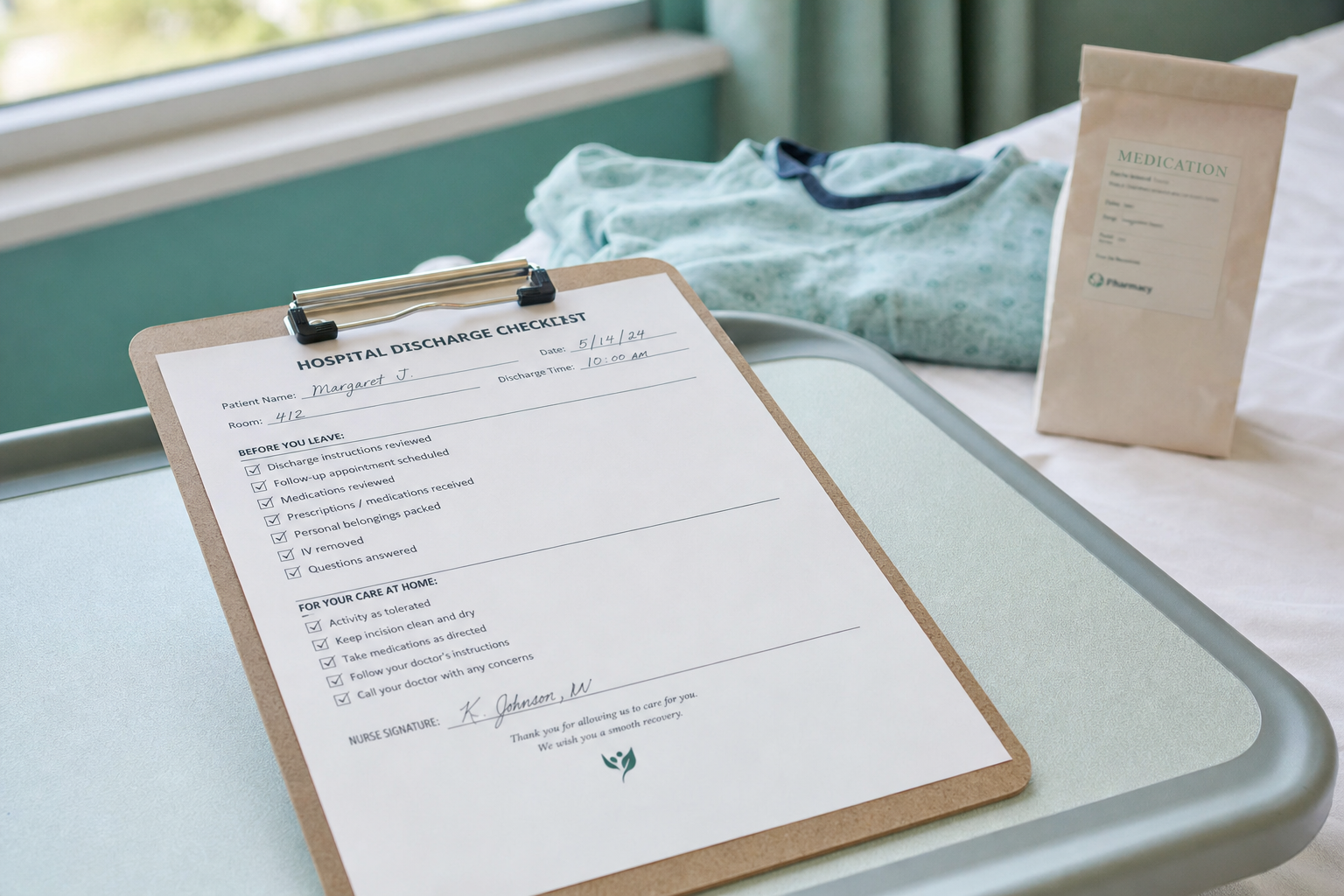

A good hospital discharge planning checklist for transportation comes down to five things: the right level of service (ambulatory, wheelchair or stretcher), a realistic pickup time, the exact pickup spot inside the hospital, a clear picture of the home or facility at the other end, and one person who can answer the phone if plans change. Get those right and the ride home is the easy part of the day. Book it at least three hours ahead for a same-day discharge, or the day before if you can, and H&M Transport can take it from there.
This guide is written for the people who actually make discharges happen: case managers, social workers and discharge nurses at hospitals across Northern Virginia, DC and the Maryland suburbs, and the family members who get the phone call saying “your mother is going home today.”
The hospital discharge planning checklist for the ride home
Before anyone calls for a ride, run through this list. Each item answers a question our dispatchers will ask, and having the answers ready turns a ten-minute call into a two-minute one.
- Level of service. Can the patient walk to a vehicle with a steadying hand, do they need to stay seated in a wheelchair, or do they need to lie flat the whole way? This is the single most important decision on the list.
- Pickup location. Hospital name, building, floor, unit and room number. Large campuses have several entrances, and “the main lobby” is rarely specific enough.
- Estimated discharge time. The time the patient will realistically be ready, not the time the order was written.
- Destination details. Full address, apartment or room number, gate or door codes, and whether there are steps, an elevator or a narrow hallway.
- Weight. If the patient is over 300 pounds, say so on the first call so we send a bariatric vehicle and crew.
- What’s going home with them. Walker, wheelchair, portable oxygen, bags, a folder of discharge paperwork. Oxygen matters most, because we need to know the flow rate and whether the patient has enough for the trip.
- A contact on each end. A direct line on the unit (not the hospital switchboard) and a family member or facility nurse at the destination.
- Who is paying. Private pay, a facility account, or a Medicaid ride booked through a broker. Each one is booked a little differently.
Print it, paste it into your discharge template, or keep it on your phone. The families who have it filled out before they call are the ones whose rides go smoothly.
Choosing the right level of service before discharge
The wrong vehicle is the most common reason a discharge ride stalls in the hospital driveway. A patient who walked into the emergency department a week ago may not be able to walk out, and the person who knows best is the nurse who has watched them move that day. Ask the nurse or physical therapist directly: did the patient walk to the bathroom, or use a bedside commode? Can they sit upright for 45 minutes?
Ambulatory
For patients who can walk with some help. The driver provides door-through-door assistance: a steady arm from the bedside or lobby to the van, and from the van into the home. Ambulatory riders travel in the same minivans and full-size vans as the rest of our fleet. Most short-stay discharges fall here.
Wheelchair
For patients who can sit upright but shouldn’t be walking any distance. The rider stays in the chair the whole trip; the chair rolls up a ramp on our minivans or onto a hydraulic lift on our full-size vans and is secured with four-point tie-downs. If the patient doesn’t have a wheelchair of their own yet, we can bring one at no extra cost. See wheelchair transport for more.
Stretcher
For patients who can’t sit up safely for the length of the ride: after certain surgeries, with significant weakness, with wounds that make sitting painful, or going home on hospice. Stretcher trips are bed-to-bed and always have at least two crew members with power-assisted cots. Read more about stretcher transport.
Bariatric
For riders over 300 pounds, in wheelchair or stretcher configuration. We use specialized vehicles with wider ramps and roomier interiors, and we add a second crew member when the transfer or the route out of the home calls for it.
One more point for the checklist: H&M Transport is not an ambulance. Our crews don’t provide medical care or monitoring on board. If a patient needs cardiac monitoring, IV management or a paramedic during the ride, that trip belongs with an ambulance service.
Timing the pickup: when to book discharge transportation
Discharges slip. The order gets written at 9 a.m., then the patient waits for a final medication reconciliation, a pharmacy delivery, a last consult or the attending’s signature, and the real departure is mid-afternoon. A ride booked for 10 a.m. either waits (and prescheduled waiting is billed by the hour) or leaves and has to come back.
A few habits help:
- Book early, confirm late. Call as soon as discharge looks likely, even the day before, then confirm the time once the paperwork is actually moving. Booking 24 hours ahead guarantees availability.
- Give us three hours for same-day discharges. That’s our minimum notice for same-day requests and discharges. Dispatch answers 24/7, holidays included, so an evening or weekend discharge is fine.
- Call as soon as timing changes. Changes or cancellations made at least two hours before pickup don’t carry a fee.
- Tell us about the destination’s schedule. Skilled nursing and rehab facilities often have admission cut-off times. If a facility wants the patient before 4 p.m., tell us so we can plan backward from that.
Hospitals, skilled nursing facilities and other partners with an account book on contracted rates, and facility discharges run on a three-hour maximum lead time. If you’re a case manager who sends patients home regularly, our facility partner page explains how to set that up.
Discharge planning in Fairfax, Manassas and across the region
Most of our discharge trips start at hospitals in Northern Virginia. From Inova Fairfax Hospital and Inova Fair Oaks to UVA Health Prince William Medical Center in Manassas, Sentara Northern Virginia Medical Center in Woodbridge and VHC Health in Arlington, our dispatch team in Gainesville knows the patient pickup areas and the traffic between them.
Regional quirks worth adding to your checklist:
- Crossing state lines. Plenty of patients are discharged from a hospital in one jurisdiction and go home to another: a Holy Cross Hospital patient heading to a daughter’s house in Fairfax, or an Arlington patient going to rehab in Montgomery County. H&M Transport holds Virginia DMV Certificate #524 and WMATC authority 3449, which covers trips across Virginia, DC and Maryland within the Washington Metropolitan District.
- Rush hour. A 3 p.m. discharge from Fairfax to Prince William can take far longer than the same trip at 11 a.m. Build that into the destination’s arrival window.
- Longer trips home. Patients sometimes finish specialty care here and go home to Winchester, Fredericksburg or farther. Trips over 50 miles are priced as long-distance transport, so ask for a quote when you book.
Preparing the home or facility before the patient arrives
The ride ends at a door, and that door is often where problems show up. Ask the family (or the receiving facility) a few questions before discharge day:
- How many steps are there to get inside, and is there a railing? A wheelchair rider who can’t manage steps may need our stair chair team.
- Is the hospital bed, commode or other equipment already delivered and set up?
- Will someone be home to meet the patient and receive medications and paperwork?
- Is there parking close to the entrance for a full-size van?
- For a facility: has the admission been confirmed, and which entrance and unit should the crew use?
A family member or caregiver can usually ride along; tell us when you book so we plan the seating.
What discharge transportation costs
For private-pay patients, a one-way wheelchair or ambulatory discharge is $90 plus $3.00 per mile, so a 10-mile trip home comes to $120. A stretcher discharge is $260 plus $4.00 per mile; the same 10 miles comes to $300. Add-ons such as the stair chair team, oxygen or after-hours pickups (before 7 a.m. or after 6 p.m.) are listed on our rates page. Rates are the same in Virginia, Maryland and DC.
Coverage is the other half of the question. Original Medicare does not cover wheelchair or stretcher vans, though some Medicare Advantage plans include a transportation benefit. For Virginia Medicaid members: call the transportation number on your Medicaid ID card; the brokers we work with are MTM Health and SafeRide Health. Request H&M Transport specifically when you book your ride. In DC, we serve UnitedHealthcare Community Plan of the District of Columbia members through SafeRide Health. We are not a Medicaid provider in Maryland.
For more on the whole process, from paperwork to what happens at the curb, see our hospital discharge transportation page.
Common questions
How far ahead should I book transportation for a hospital discharge?
As early as you know discharge is likely. We need at least three hours for same-day discharges, and booking 24 hours ahead guarantees availability.
What if the discharge gets delayed?
Call dispatch as soon as you know, at (703) 304-7889. Changes made at least two hours before pickup carry no fee, and we’ll move the ride to the new time.
Can you take a patient from the hospital to a rehab facility or nursing home?
Yes. Stable, scheduled transfers from a hospital to rehab, a skilled nursing facility or hospice are routine for us. We don’t do hospital-to-hospital transfers for a higher level of care or trips to an emergency room; those need an ambulance.
Does the patient need their own wheelchair?
No. If the patient doesn’t have one, we can bring a wheelchair at no extra cost. Just mention it when you book.
Can a family member ride along?
A family member or caregiver can usually ride along. Tell us when you book so we can plan for them.
Book the ride home
Once you’ve worked through the checklist, booking takes a few minutes. Book online or call dispatch at (703) 304-7889, any hour of the day. Tell us whether the patient needs ambulatory, wheelchair or stretcher service, and we’ll have the right vehicle and crew at the unit when they’re ready to go home.